
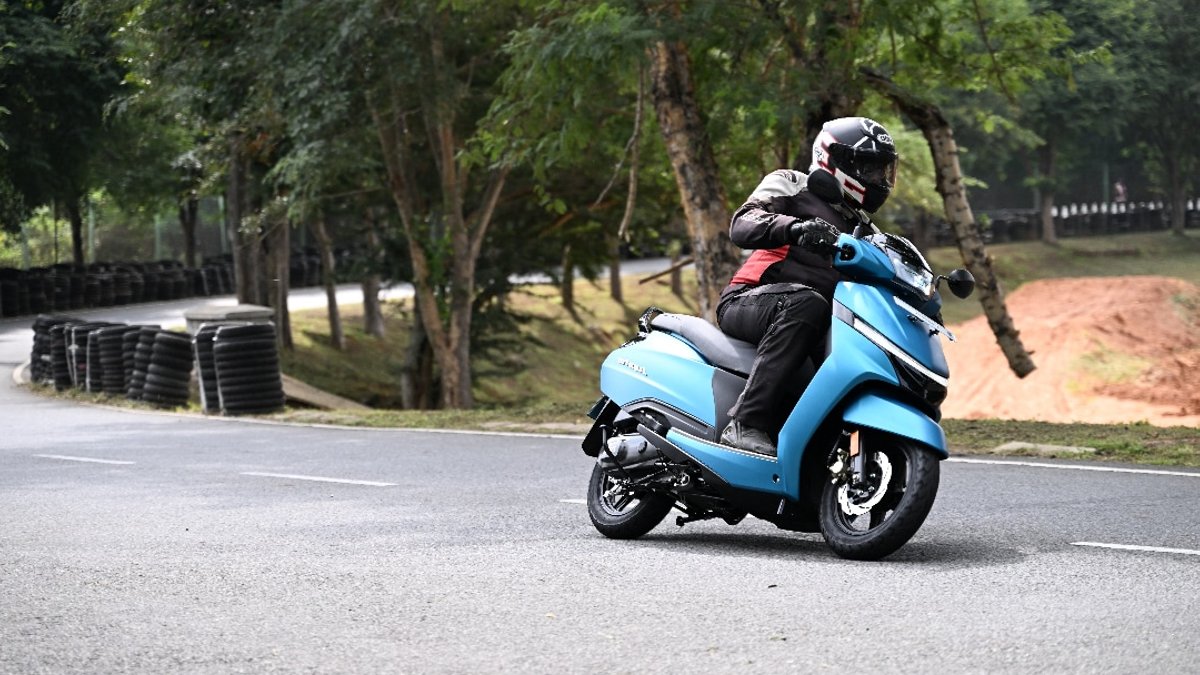
The TVS Jupiter 110, a bestseller for over a decade, has undergone a significant generational change in 2024, with a new engine, chassis, and updated design and features. We got a pre‑launch ride at the TVS test track in Hosur and here’s what’s new.
Design and Features
The top‑spec variant of the 2024 TVS Jupiter 110 comes with a modern, futuristic look, featuring a long DRR and integrated turn indicators. It sports 12‑inch wheels, telescopic front suspension, a single mono‑shock at the rear, and LED lighting at both ends. The top variant also gets a disc brake up front, a hazard light switch integrated into the turn indicator buttons, and a neat reverse LCD screen displaying speed, time, trips, and real‑time fuel efficiency.
The scooter gets a piano black finish instead of chrome, and the color screen on the dash shows speed, eco, and power indicators. The scooter’s overall fit and finish is impressive, with minimal panel gaps and high‑quality plastic.
Beyond the front apron, a continuous LED strip sweeps across the rear panel, merging the taillight and turn signals into a single sleek unit. The long‑press hazard function, hidden within the indicator cluster, activates both sides simultaneously, offering an intuitive way to signal emergencies without taking eyes off the road. The piano black treatment extends to the handlebar grips and footboard, delivering a uniform, premium aesthetic that differentiates the new model from its chrome‑capped predecessors.
Attention to detail is evident in the surface treatment: paint coats are uniform, and the absence of visible screws on the bodywork shows a manufacturing precision that feels more akin to a motorcycle than a traditional commuter scooter. Even the footboard retains a matte finish that resists fingerprints, contributing to the overall perception of durability.
Engine and Performance
The Jupiter 110 is powered by a new 113.3cc single‑cylinder FI engine with features like an Intelligent Start‑Stop System and a boost feature that temporarily increases torque when the battery is fully charged. The scooter offers smooth acceleration from 0 to 60 kmph, but feels reluctant to cross the 80 kmph threshold. Despite this, it handles high speeds well due to its light and nimble new chassis.
The scooter’s performance is commendable, offering a comfortable ride with ample shove from 20 to 60 kmph. It retains the comfort factor that was popular with the older model while adding agility.
Intelligent Start‑Stop automatically kills the engine at brief stops, conserving fuel without compromising readiness. When the battery reaches full charge, a modest boost kicks in, raising the peak torque from its baseline to a higher figure, while a “power‑assist ready” cue on the dash signals that the extra torque is available for the next acceleration burst. The engine’s peak output sits around eight metric horsepower, delivering a lively response for city riding.
The braking package combines a front disc with a rear drum linked through a combined braking system, ensuring balanced stopping power. This arrangement, together with the lighter chassis, translates into confident braking even when the scooter is fully loaded.
Related: 2014 Daytona 675 vs 2024 ZX6R: Decade of Supersport Evolution
Technology and Safety
The top‑spec variant comes with Smart Connect technology, including Bluetooth connectivity, call alerts, turn‑by‑turn navigation, and start‑stop technology. Safety features include auto‑cancellation turn indicators and automatic hazard lights upon hard braking.
The scooter’s dash displays average fuel economy, riding patterns, and eco/power modes, encouraging efficient riding. The riding posture is upright and convenient, with a glovebox for added storage.
Auto‑cancellation turns off the indicators as soon as the rider completes a lane change, while a sudden brake press triggers the hazard lights, flashing both sides to alert following traffic. The lights deactivate instantly once pressure is released, preventing unnecessary distraction.
Through the Smart Connect app, riders can pair their phones to receive incoming call notifications, view trip summaries, and access navigation prompts directly on the LCD. The app also logs fuel consumption trends, helping users fine‑tune their riding style for better mileage.
Ergonomically, the seat is wide and cushioned, offering ample thigh support for longer commutes. Footboards are positioned to allow a relaxed knee angle, and the front glove compartment provides quick access to documents or a small raincoat without compromising the scooter’s sleek silhouette.
The new Jupiter 110 weighs 105 kg, has reduced weight compared to the older model, and is balanced thanks to the new chassis. It should be priced competitively, around Rs 74,000 ‑ Rs 91,000, undercutting the Jupiter 125’s price bracket.
At the entry level, the model is expected to start at Rs 54,349 ex‑Delhi, positioning it well below many rivals in the same displacement class. The reduced mass stems from extensive use of fiber‑reinforced components in place of the older steel panels, making the scooter easier to maneuver in tight city spaces and simpler to lift onto a center stand for routine maintenance.
The Jupiter 110 is a really big deal for TVS, because to put it simply, this is pretty much the bread and butter scooter model for the company. The Jupiter scooter series is the highest selling brand in the manufacturer’s scooter portfolio, managing to outshine models like the Scooty Pep+, the Zest 110 and surprisingly even the Ntorq 125 range in terms of units sold. So much so that, if say the Ntorqs are selling at a rate of 30,000 units a month, the Jupiter scooters are doing double of that in the same timeframe. That’s how much in demand they are in India. Even though these sales numbers include both the Jupiter 110cc and 125cc models combined. It still is impressive feat nonetheless.
The 2024 TVS Jupiter 110 has upped its game in terms of design, ride quality, handling, and features, making it a strong contender to dethrone the Honda Activa in its segment.


