
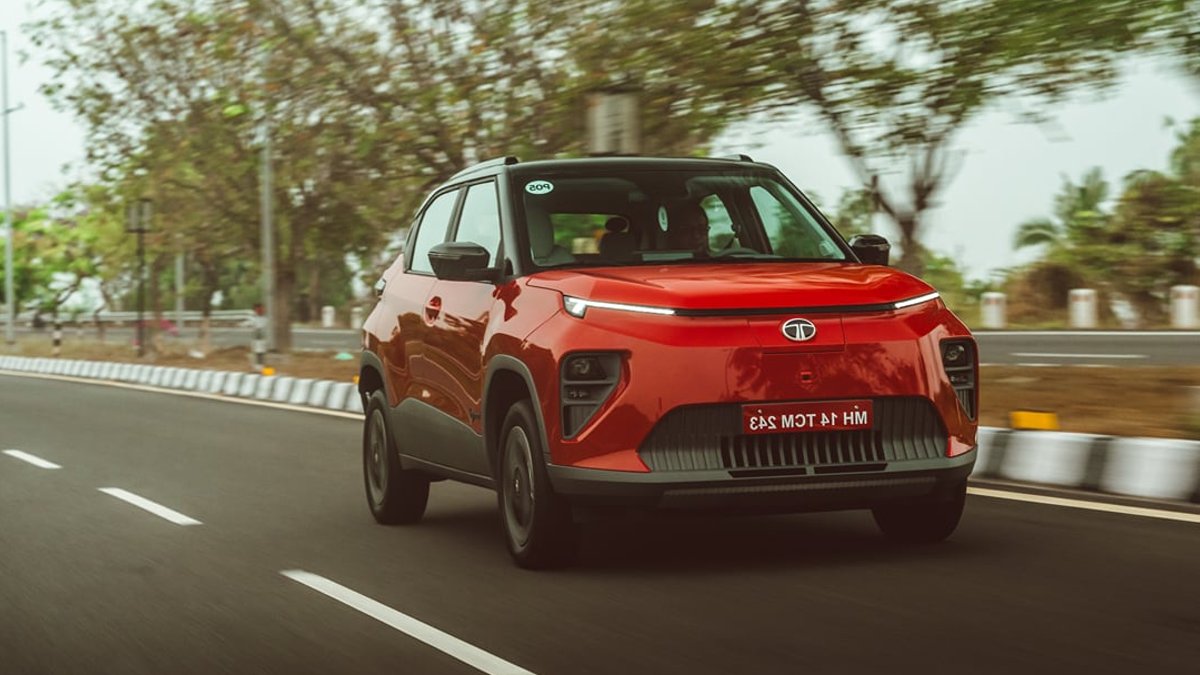
The 2026 Tata Punch EV looks nearly identical to its predecessor at first glance, but under the skin, Tata Motors has made meaningful updates to improve its appeal as an affordable electric vehicle. The changes are subtle—cleaner lighting housings, a more refined grille, and a shift from bright plastic trim to a lighter grey—but they add up to a more modern aesthetic.
The full-width LED signature from the previous model has been replaced with a more compact design, and the rear now features a full-width light cluster borrowed from the new internal combustion Punch. The alloy wheels have also been updated with fresh color options that align with the car’s younger aesthetic, while the larger battery pack has allowed Tata to maintain full-size SUV ground clearance of 195 mm and 450 mm of water wading capacity. These tweaks don’t drastically alter the car’s identity, but they help it feel fresher without losing its compact, urban-friendly proportions.
The interior remains familiar, with the same chunky, utilitarian design language Tata has used in recent models. The off-white central console still stands out with its recycled-tri-arrow texture, and the door panels retain their hard plastic surfaces—though these show scuffs more easily than they should. The 10.25-inch touchscreen, now reliable and crisp, dominates the dashboard, while the 10.25-inch driver display adds clarity for navigation and blind-spot monitoring. Fonts could still be larger, but the system works well in motion.
The gear selector and paddle shifters retain their slight delay, and regenerative braking resets to default settings every time the car starts, a minor annoyance over time. Panel gaps have been tightened to match the new ICE Punch, and some sharp plastic edges have been softened for a more refined feel. The centre console also gains a more compact window switch design, though these are slightly less intuitive than the older buttons.
Space and Accessibility Trade-Offs
Practicality is a strong suit. The 366-liter boot is deep enough for strollers and soft bags, though the high lip and lack of a 60:40 split make loading awkward. A spare wheel isn’t standard, and the frunk offers little more than space for a charging cable. Inside, the 90-degree rear doors and flat floor make access easier, though taller passengers may feel cramped.
Related: Next Maserati Quattroporte to offer both gas and electric powertrains
The seats provide surprisingly good thigh support for an EV, thanks to extended squabs that compensate for the higher floor. Cooling has improved for both the battery and cabin, though rear AC vents are still missing. The backrests feature dense cushioning that holds passengers securely, and the lack of a panoramic sunroof has helped maximize headroom for average-height occupants.
Where the 2026 Punch EV stands out is in its real-world usability. The larger battery pack delivers a claimed range improvement, though Tata has not specified exact figures. The switch to prismatic cells has improved DC fast-charging capabilities. The powertrain now produces 130 PS and 154 Nm for the larger battery option, with a wider torque band for smoother acceleration. The claimed 0-100 km/h time is now 9 seconds, a slight improvement over the previous model. The smaller battery variant now offers 88 PS and 154 Nm.
Smooth but Not Sporty Ride
The driving experience is straightforward and forgiving. City speeds feel manageable, and the car handles well on highways, though front-wheel drive can struggle in low-grip conditions. The ride is firm over rough surfaces but settles into a confident, plush feel at higher speeds. Steering lacks feedback at the center, making precise inputs harder to judge, but the car’s low mass keeps it nimble. It’s not a driver’s car, but it’s easy to live with, ideal for daily commutes and occasional longer trips. The car’s tight turning radius and decent visibility, despite the large A-pillar, make urban maneuvering manageable.
Affordable EV with Smart Cost Cuts
Pricing starts at Rs 5.49 lakh (ex-Delhi), with the top-spec model at Rs 12.59 lakh. A Battery-as-a-Service (BaaS) option further reduces upfront costs, making the Punch EV one of the few affordable EVs in its segment with this level of range and features. The trade-offs, hard plastics, limited rear space, are outweighed by its practicality and value. For buyers prioritizing affordability and everyday usability over premium materials, the 2026 Punch EV delivers more for less. The car’s CCS Type 2 charging port and improved battery cooling also enhance its long-term reliability, making it a compelling choice in a crowded entry-level EV market.
The 2026 Punch EV isn’t revolutionary, but it’s a smart evolution, a car that keeps its strengths while addressing minor frustrations. For the right buyer, it’s a no-nonsense electric runabout that ticks most boxes without asking for much in return.


