
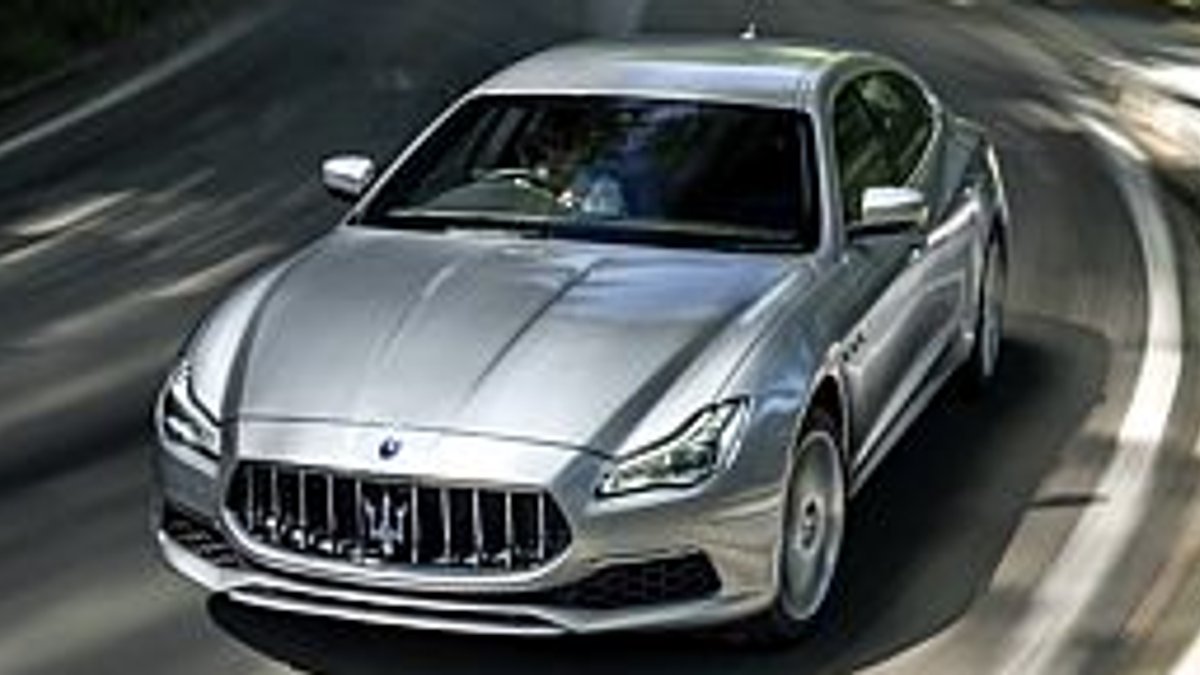
Next Maserati Quattroporte to offer ICE, EV
Two architectures for the new flagship
Maserati is advancing the development of replacements for its Quattroporte flagship sedan and Levante large SUV models with both combustion engine (ICE) and battery-electric (BEV) powertrain options, while the door has been left open to a Chinese-style range extender (REEV) in future.
Head of Maserati Engineering Davide Danesin confirmed the two large models are being worked on, with the company set to announce its chosen architectures and partnership structures at a planned strategy update event in December.
“It’s true that we are in development. We are still in a phase where we’re comparing different (platform) concepts,” Mr Danesin told GoAuto.
Both models are set to retain their traditional positioning, with Mr Danesin confirming that the “future Quattroporte must be closer to a sedan than an SUV” despite other flagship models drifting toward the crossover space in recent years.
He confirmed that the Quattroporte would remain sedan-like “in terms of proportion, in terms of general dimension characteristics like vehicle height or wheel size, suspension travel, and so on.”
Related: New safety rules take effect in 2029
Parent company Stellantis announced in May that it had committed long-term to Maserati, and that the Italian marque would receive two new E-segment models.
At the time, alliance chief executive Antonio Filosa confirmed talks with two potential partners, with Chinese reports linking JAC and Huawei to a possible collaboration.
Mr Danesin confirmed that, whatever platform approach is chosen, the decision has already been taken to preserve the choice of a high-performance pure ICE powertrain alongside a zero-tailpipe emission BEV alternative to satisfy the demands of buyers in different regions.
The Maserati engineering boss said that retaining the possibility of a serious combustion option was a condition of any potential co-operation.
Combustion and electrification will be marketed as completely distinct choices and Mr Danesin unequivocally confirmed that there will not be a plug-in hybrid (PHEV) option to bridge the gap.
“We’re actually not pursuing any plug-in hybrid at the moment, because we don’t believe it’s a good solution for us, because of the weight of the battery,” he said.
That position does not rule out the use of milder hybrid technology (such as a 48-volt system or a full hybrid), with Mr Danesin telling GoAuto that tightening emissions rules are making such additions inevitable—but Maserati feels today’s PHEV tech is not the right fit.
Related: Chevrolet Silverado avoids ADR rules with reclassification
Maserati is open to longer-range REEV technology—where a combustion engine generates electricity only for the battery and where the vehicle drives like a BEV—if it can beat the offer of a full BEV on key metrics.
“If we can prove that somehow REEV can be efficient in terms of weight and cost, I’m fine to make it,” he said.
The likely combustion anchor for the Quattroporte and Levante lines remains Maserati’s 3.0-litre twin-turbo Nettuno V6, which the company says can be adapted for higher requirements under Euro 7.
Euro 7 applies generally to new passenger-car types from November this year and all new cars from late 2027, but small-volume manufacturers receive a reprieve until mid-2030.
The European Union definition covers manufacturers registering fewer than 10,000 passenger cars annually in the bloc, subject to group and production conditions.
Mr Danesin said Maserati expects 11,000-12,000 global annual sales, of which Europe represents 30-40 per cent, leaving it comfortably below the EU threshold.
Related: 33 Professional Tips to Improve Your Auto News Content
The Euro 7 Nettuno upgrade is targeted for around the end of 2029 and may use hybrid assistance to improve transient response.
“We’re not foreseeing major power limitations as others are doing because of this technology,” he said.
While it has been understood that the Quattroporte and Levante would share one platform, hints have emerged that this may not be the case.
Mr Danesin said that while the Levante SUV can be more readily created from a partner platform, the Quattroporte’s considerably richer legacy meant that it must preserve recognizably Maserati proportions and dynamic characteristics.
“There are products that are more critical for DNA definition, and products that are a little bit—because of their positioning—maybe more flexible to be adapted. The Quattroporte is very much a Maserati product that needs very careful management in terms of contents and character…some other products, such as maybe the Levante, we can be a little bit more open about it.”
Stellantis is currently working on a dedicated EV platform for its high-end brands, but Maserati remains a small-volume producer by EU standards. This technical flexibility allows the company to explore unconventional hybrid configurations that larger automakers might find too complex or costly to justify.


