
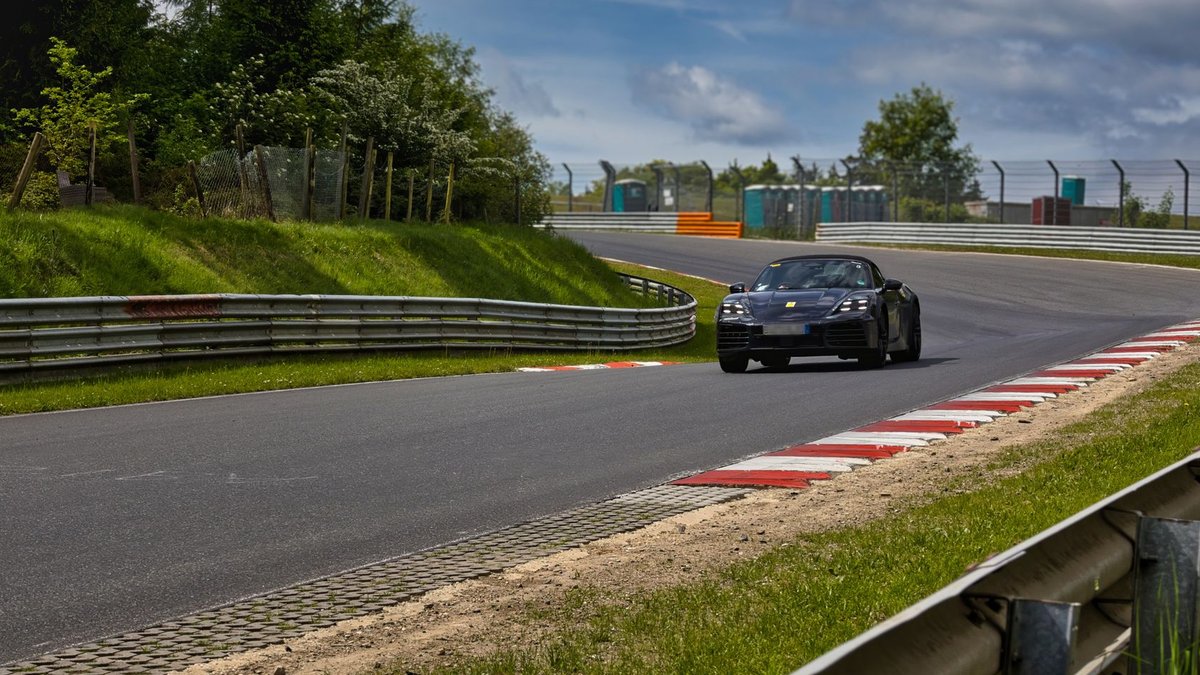
BMW’s upcoming electric M3 has been caught drifting on the Nürburgring, its tires leaving marks across all four wheels as it handles one of the track’s most challenging corners. The images highlight the car’s potential to merge raw power with exacting handling—qualities that could distinguish it from its closest competitor, the Xiaomi SU7 Ultra. The Chinese model currently holds the production-spec electric car lap record for the Nordschleife at 7:04.957 minutes, though it was later surpassed by Porsche’s Taycan Turbo GT in 2026.
The electric M3 is still under development, but leaked footage reveals it pushing boundaries on the Nürburgring, a circuit notorious for exposing weaknesses in even the most polished performance vehicles. Unlike standard test sessions where cars follow measured runs, these images show the M3 executing a controlled four-wheel drift, a maneuver demanding both power and chassis sophistication. This approach contrasts with the SU7 Ultra, which emphasizes sheer speed over driver interaction.
Xiaomi’s SU7 Ultra made headlines in 2025 when it set a production-spec lap time of 7:04.957 on the Nordschleife. Two months later, a prototype version improved that time to 6:22.091, the third-fastest ever recorded on the track. Its power comes from three electric motors, two “V8” models at the back and a “V6” on the front, generating 1,138 kW (1,526 hp) in a vehicle roughly the size of a Mercedes C-Class. In comparison, the electric M3 is expected to produce 680–750 hp in its base configuration, rising to about 810 hp in a later CS version. While still impressive, this places it behind the SU7 Ultra in raw output.
Read Also: BMW launches Alpina as independent brand
However, speed alone does not define performance. The electric M3’s advantage may lie in its ability to deliver power with precision. Early details suggest it will use four electric motors, one per wheel, to enhance grip and drift control. The car’s electronic architecture, initially codenamed Hand of God and later renamed Heart of Joy for production, indicates BMW is balancing brute force with driver engagement. The Nürburgring footage supports this: the M3 isn’t just fast; it’s responsive, a quality that sets it apart from the SU7 Ultra, which prioritizes acceleration over cornering finesse.
The SU7 Ultra accelerates from 0–62 mph in 1.98 seconds and reaches a top speed of 217 mph, figures that exceed the electric M3’s projected 0–62 mph in 2.5 seconds. Yet the M3’s four-wheel-drive system and BMW’s legacy for driver-centric engineering may give it an edge in real-world engagement. The Nürburgring images suggest a car that doesn’t just move quickly; it immerses the driver in every turn.


