
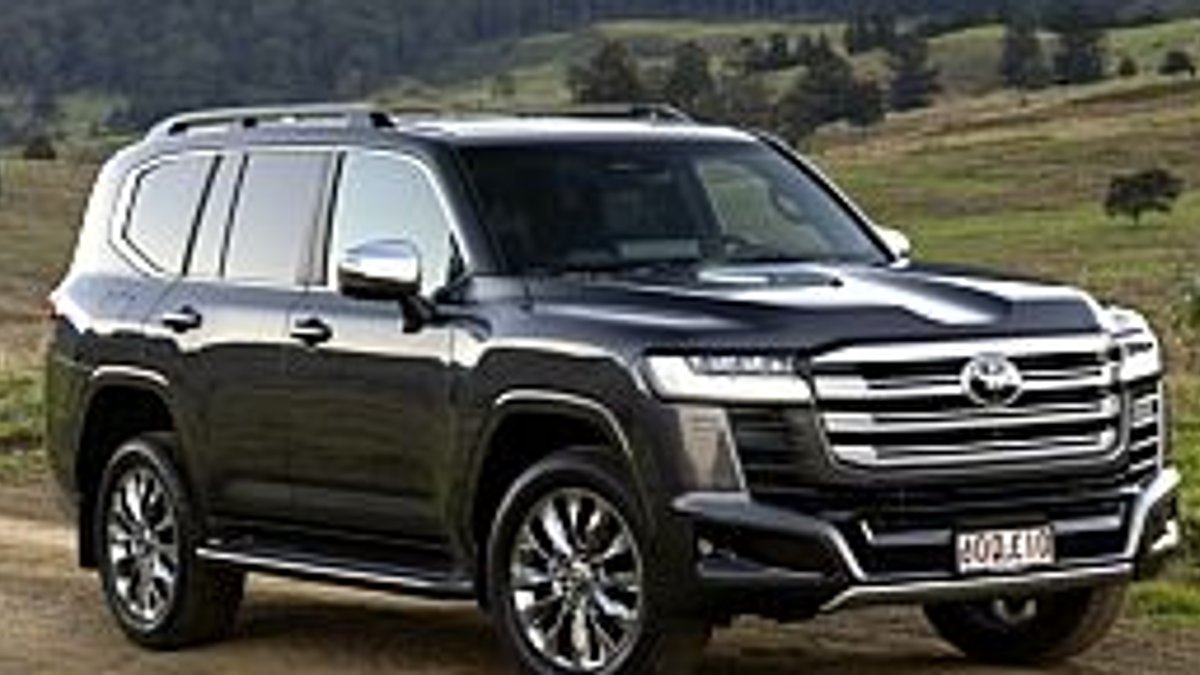
The Toyota LandCruiser 300 Performance Hybrid arrives in Australia as part of Toyota’s push toward electrification, though its focus remains on offering buyers an alternative to diesel rather than maximizing efficiency.
Hybrid powertrain borrows from the Tundra, with a $9K premium
Toyota’s strategy includes increasing the share of electric, plug-in hybrid, and fuel-cell vehicles to 30% of its 2030 sales. The LandCruiser 300 Performance Hybrid, featuring a twin-turbo V6 petrol engine and electric motor, aligns with this plan—at an additional cost.
The hybrid system, called i-Force MAX, comes from the U.S.-market Tundra pickup. In this model, the 3.5-liter V6 generates 305kW at 5,200rpm and 650Nm from 2,000-3,600rpm, paired with a 36kW/250Nm electric motor. Together, they produce 341kW and 790Nm, surpassing the diesel’s 227kW and 700Nm.
A 1.87kWh nickel-metal-hydride battery sits beneath the cargo floor, reducing seating capacity to five. The system doesn’t support extended electric-only driving but improves acceleration and low-end torque.
Pricing begins at $155,990 for the GR Sport and $156,740 for the Sahara ZX before on-road costs. This represents a $9,000 increase over equivalent diesel versions, which may deter budget-conscious buyers.
Related: Chevrolet Silverado avoids ADR rules with reclassification
Fuel economy lags behind diesel, but performance stands out
The diesel LandCruiser 300 achieves 8.9L/100km combined, offering a theoretical range of 1,236km from its dual fuel tanks. The hybrid, requiring 95RON premium, averages 10.0L/100km and reaches 980km on a single 98-liter tank.
On highways, the difference narrows—7.6L/100km for the diesel versus 8.0L/100km for the hybrid. In urban settings, the diesel performs better at 11.1L/100km compared to the hybrid’s 13.7L/100km. During a test drive in rural Queensland, the Sahara ZX hybrid recorded 13.1L/100km on a relatively undemanding route.
The hybrid’s strength lies in its refinement. The petrol V6 revs more freely than the diesel, while the electric motor’s instant torque enhances acceleration. The hybrid weighs 115kg more than the diesel but doesn’t feel sluggish.
A practical benefit is the 220V/1500W AC power outlet in the boot, a feature missing from the diesel. For buyers prioritizing comfort and convenience over range, this trade-off may justify the higher price.
Off-road capability remains strong, with minor trade-offs
The hybrid retains the diesel’s 3,500kg braked towing capacity and locking center and rear differentials. The Sahara ZX hybrid includes Multi-Terrain Select, though it lacks the e-KDSS found in the GR Sport, which automatically disconnects anti-roll bars for better articulation.
On dirt and gravel, the hybrid’s adaptive suspension and 265/55R20 Bridgestone tires handled bumps well, though the 20-inch wheels on the Sahara ZX aren’t ideal for rough terrain.
Related: 33 Professional Tips to Improve Your Auto News Content
Inside, the hybrid matches the diesel’s luxury features, including four-zone climate control, heated and ventilated seats, and a refrigerated center console. The Sahara ZX adds a dual rear-seat entertainment system, while both trims share a 14-speaker JBL stereo and multiple USB-C and HDMI ports.
Servicing costs remain identical to the diesel: $450 per visit for the first five years or 100,000km, with intervals every six months or 10,000km.
The hybrid LandCruiser 300 isn’t a mass-market choice. It’s heavier, consumes more fuel, and carries a higher price than the diesel, without clear advantages in range or efficiency. Yet for buyers seeking a quieter, smoother, and more powerful option—and who can afford the premium—it presents a strong case.
Whether Toyota will extend the hybrid powertrain to lower-spec models like the GXL remains uncertain. At over $156,000, the hybrid is beyond many LandCruiser buyers. If diesel prices rise, however, its appeal could increase, even if it isn’t the most logical choice on paper.
For now, the Performance Hybrid serves as a luxury upgrade rather than a necessity. In a segment where tradition often outweighs innovation, this move signals progress. The shift aligns with broader trends in automotive journalism, where performance and sustainability increasingly intersect.


